

Elbow Injections
Your elbow is the intersection of three bones: the humerus of your upper arm and your two forearm bones, the radius, and the ulna. Not only is your elbow flexible, allowing your arms to bend and twist, but it's also the conduit for important nerves that control the fine movements of your hands and fingers. When you experience elbow pain, whether, from an injury or ailment, it impacts what you can and can't do — at work, at play, and even at rest.
Your elbow certainly can take a beating from playing sports. Baseball, tennis, and golf — any racquet sport, for that matter — put stress on your elbow. If you play often enough, the wear and tear can eventually irritate the muscles, tendons, and ligaments that hold your elbow together and allow you to make all those complex movements.
Elbow Injection NYC — SPIN Sports Pain Specialists
Ready to get relief from elbow pain?
Same-day elbow injection appointments available.
Looking for Elbow Experts
If one or both of your elbows are hurting, make an appointment with the Sports and Pain Institute of New York. Sports injury specialist examines you and takes a complete medical history, which includes the sports you play and when you noticed the pain. You can get help in this medical practice even if your injury isn't sports-related.
The first course of action, after your physician reaches an accurate diagnosis, is to pursue conservative treatment options. Rest is the first option. If you were playing sports, stop to allow your elbow to heal. Over-the-counter non-steroidal anti-inflammatory drugs (NSAIDs), such as aspirin or ibuprofen, may help ease your pain and inflammation. Physical therapy is another possible treatment.
Finding Pain Relief from Elbow Woes
If those non-aggressive alternatives don't provide the kind of pain relief you need, the next level of treatment involves steroid injections:
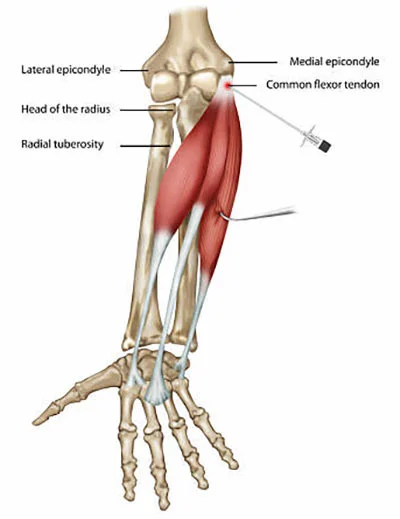
Tennis elbow injection delivers pain relief and anti-inflammatory medication directly to the area on the outside of your elbow.
Golfer's elbow cortisone injection into your inner elbow eases your pain by reducing the inflammation and stiffness.
Elbow injections for other ailments, such as cubital tunnel syndrome, relax your ulnar nerve, allowing you to grip things without tingling in your fingers.
Cortisone is a steroid-based medicine that's in common use today. It reduces inflammation, which allows your muscles and tendons to heal by themselves. Instead of waiting months, you may heal enough to get back to your game of choice in weeks. And while cortisone isn't a cure by itself, it eases your pain for months at a time. Rest, ice and stretching do the rest.
Tennis Elbow Injection
Tennis elbow, also known as lateral epicondylitis, strikes when you've aggravated the muscle and soft tissue of your outer elbow. These muscles connect your forearm muscle to your elbow. If you've developed tennis elbow, you probably know it, as the pain from your elbow when you move it is the main symptom. Swelling and tenderness may also be present.
You don't have to play tennis to get tennis elbow. It's caused by repetitive arm, wrist, and hand movements. That can be swinging a tennis racquet or stocking shelves. Your doctor can provide a tennis elbow injection to start you on the path back to full health.
Golfer's Elbow Cortisone Injection
Golfer's elbow, also called medial epicondylitis, upsets the muscles on the inside of your elbow. These are the ones that connect your inner forearm to your elbow. It's caused by the kind of pressure simulated by swinging a golf club — basically, the force placed on your wrists and fingers.
If you need a golfer's elbow cortisone injection, your elbow is stiff and you've lost strength in your hands. You may even be feeling tingling down to your fingers. The injection puts steroid medication where it's most needed, to calm the inflammation and promote healing.
Getting an Injection in Your Elbow
It doesn't hurt, first of all. After making you comfortable in the office, your sports and pain physician numbs the area where the injection goes. The injection itself takes just a few minutes. Afterward, you should feel immediate pain relief, as the injection also contains a local anesthetic for short-term relief. After that wears off, your pain may return, but once the steroid medication starts working, in a few days, you should feel a significant pain reduction.
Cortisone injections are safe, and their effectiveness lasts for several months. You can only have these tennis elbow injections or golfer's elbow cortisone injections three or four times a year. They are not an answer for chronic pain.
Ready to find relief from elbow pain?
Dr. Melepura's Midtown Manhattan clinic offers same-day appointments for evaluation and treatment.
100+ Real Stories from Our Patients







Dr. Febin Melepura, MD
Double Board-Certified Pain Specialist
Meet Dr. Febin Melepura - Your Elbow Injection Specialist in NYC
Dr. Febin Melepura, MD is a double board-certified interventional pain management specialist and the founder of the Sports Pain Institute of New York. He completed his residency and fellowship training at New York Presbyterian Hospital / Columbia University Medical Center, one of the nation's leading academic medical centers.
He holds dual board certifications from the American Board of Anesthesiology and the American Board of Pain Medicine, and has treated more than 7,500 patients and performed over 5,250 procedures throughout his career. He has been named a Top Pain Management Doctor in New York and one of America's Top Doctors™ by Castle Connolly.
Dr. Melepura's approach to elbow pain is rooted in precision: identify the exact source, treat it with a targeted injection, and get you back to your daily life as quickly as possible.
1,700+ Patient Reviews

"Able to make an appointment to see Dr. Melepura on short notice… attentive to my concerns… Jazmin was also very kind and helpful."

"Excellent hospitality, listener and explainer… highly recommend the doctor and the place."
"Dr. Melepura is the best! He worked with me to find the optimal solution to my shoulder pain while I was preparing for a fight!"
"Lovely, bright and modern… doctor and staff were kind… felt my concerns were heard."
"Helpful and friendly staff who gladly follows up with you if and when needed. Dr Melepura was very helpful and professional as well as provided me with excellent information and feedback."
"Dr Febin is fantastic! Highly recommend him and his practice the Spin clinic. The doctor is a good listener, kind, attentive and gave me great advice. "
"Dr.Melepura was very efficient and interpersonal, felt like he was understanding the problems I was having and explained the processes to take to rehabilitate. I would recommend."
"I felt listened to and truly understood by Dr. Melepura. Started PT the very next day. They were very friendly and I didn't feel rushed at all. Already recommended them to my friends who have or continue to play through pain."