
- (212) 621-7746
- text us
- BOOK ONLINE Same Day Appointments
The most common mistake patients make after a knee injury is using their ability to walk as a measure of severity. Walking is possible with a torn ACL, a meniscus tear, and even certain fractures. The real indicators of a serious knee injury are specific symptoms that point to structural damage inside the joint, and knowing what to look for can mean the difference between catching a treatable problem early and letting it become a chronic one.

As an interventional pain specialist who evaluates knee injuries daily at our Manhattan practice, Dr. Melepura has identified a pattern: patients who wait weeks to get evaluated because “I can still walk on it” often end up needing more extensive treatment than those who come in within the first few days. This guide explains exactly what to look for, what each symptom means, when to go to the ER versus scheduling a specialist appointment, and what treatment options exist beyond the outdated choice between rest and surgery.
The knee joint is remarkably good at compensating for damage. The surrounding muscles, remaining ligaments, and even swelling itself can temporarily stabilize an injured knee well enough to walk, climb stairs, and go about daily activities. This compensation masks the severity of the underlying problem.
A torn ACL allows walking because the other three ligaments (PCL, MCL, LCL) still provide partial stability. A meniscus tear allows walking because the remaining intact portion of the cartilage still cushions the joint. A non-displaced fracture allows walking because the bone fragments have not shifted. None of these injuries are minor, and all of them benefit from early diagnosis and treatment.
The better question is not “can I walk?” but rather: did I feel a pop, is the knee swelling, does it feel unstable, and can I bend and straighten it fully? These are the symptoms that reveal what is actually happening inside the joint.
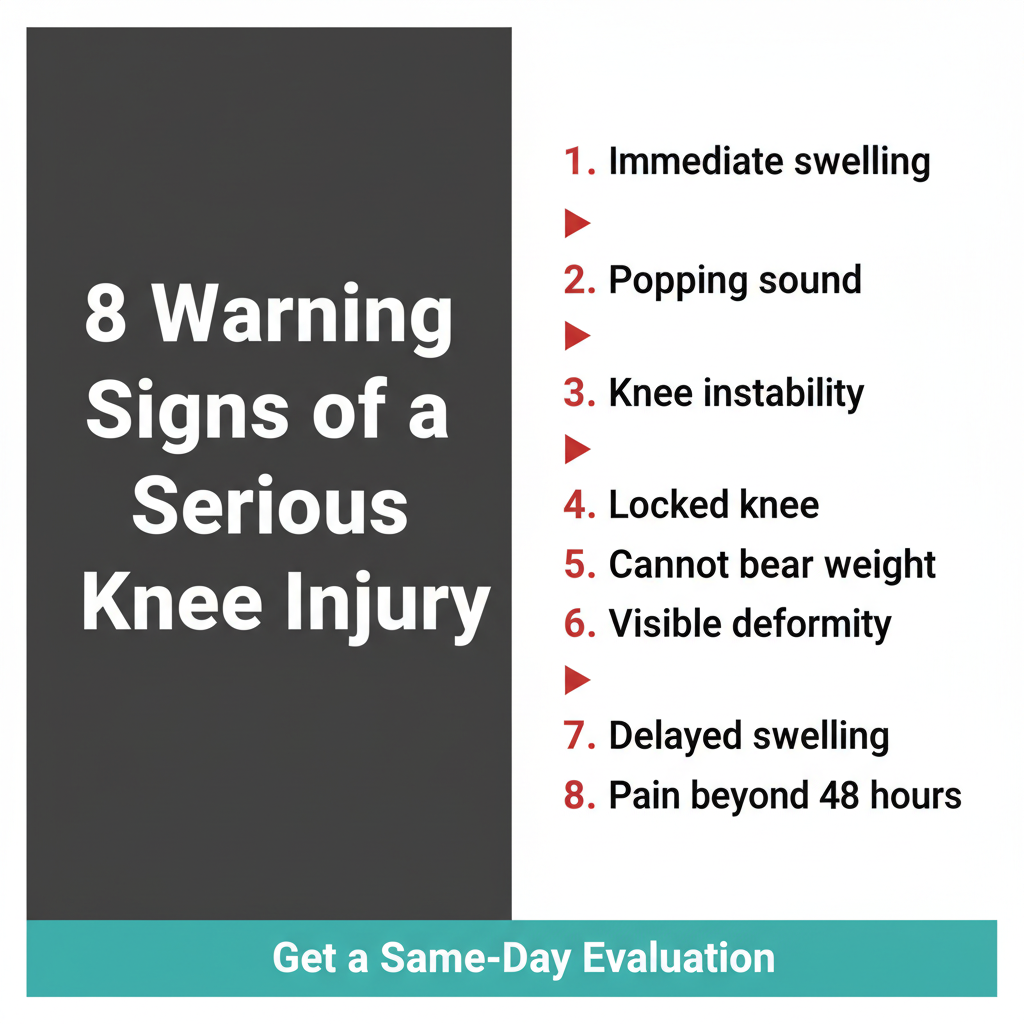
Rapid swelling that develops within 1 to 2 hours of injury is one of the most reliable indicators of significant damage. This type of swelling, called hemarthrosis, is caused by bleeding inside the joint. In clinical studies, over 70 percent of patients presenting with acute hemarthrosis are found to have an ACL tear, with the remainder having a patellar dislocation, meniscus tear, or osteochondral fracture.
This is different from the gradual swelling that appears 6 to 24 hours after an injury, which is typically an inflammatory response and suggests a less acute process like a meniscus tear, cartilage irritation, or ligament sprain.
An audible or felt “pop” during the injury event is strongly associated with a ligament tear, most commonly the ACL. Patients consistently describe it as a distinct snapping sensation, often followed by immediate instability and swelling. A pop can also indicate a patellar dislocation (the kneecap shifting out of its groove) or a significant meniscus tear.
Not every pop means a complete tear, and not every tear produces a pop. But if you felt a definitive popping sensation during your injury, schedule an evaluation within the week rather than waiting to see if it improves.
If your knee buckles, gives way, or feels like it cannot support your weight during walking, pivoting, or going down stairs, a ligament is likely compromised. ACL insufficiency is the most common cause of functional instability. MCL and LCL injuries cause instability with side-to-side stress. A large meniscus tear can also cause the knee to feel unreliable during movement.
Mechanical locking, where the knee physically cannot move past a certain point, indicates something is caught inside the joint. The most common cause is a displaced meniscus flap that wedges between the joint surfaces. Loose bodies (fragments of cartilage or bone floating in the joint) can produce intermittent locking that comes and goes unpredictably.
True locking is different from stiffness. Stiffness is a gradual limitation from swelling or muscle guarding. Locking is a sudden, hard stop where the knee physically cannot move further regardless of effort.
If you cannot stand on the injured leg or take more than a few steps without significant pain, the injury warrants urgent evaluation. Complete inability to bear weight raises concern for a fracture (tibial plateau, patella, or femoral condyle), a complete ligament rupture, or a patellar dislocation. This is one of the clearest indicators for same-day medical evaluation.
Any visible change in the shape or alignment of the knee, including the kneecap appearing displaced to one side, the lower leg angling abnormally, or a large, tense swelling, requires emergency evaluation. These findings suggest a dislocation, displaced fracture, or severe ligament disruption.
Swelling that develops gradually over 6 to 24 hours after an injury is less alarming than immediate swelling but still indicates damage. Common causes include meniscus tears, mild to moderate ligament sprains, cartilage injuries, and bursitis. The knee may feel tight, warm, and difficult to fully bend.
Delayed swelling generally warrants a specialist appointment within the week rather than an ER visit, unless it is accompanied by instability, locking, or inability to bear weight.
Mild knee pain after a twist, fall, or awkward landing often resolves within 48 to 72 hours with rest and ice. Pain that does not improve or worsens over this timeframe suggests a structural problem that will not heal on its own. This is particularly true if the pain is localized to one specific area of the knee rather than being diffuse.
Knee sprains range from mild stretching to complete ligament tears, and the severity determines whether you need professional treatment or can manage at home.
Grade 1 (mild): The ligament is stretched but not torn. You have pain with certain movements, mild swelling, and the knee still feels stable. This typically resolves with 1 to 3 weeks of activity modification and does not require imaging.
Grade 2 (moderate): The ligament is partially torn. Moderate swelling, pain with weight bearing, and some instability during side-to-side or pivoting movements. Professional evaluation is recommended to assess the extent of the tear and guide rehabilitation.
Grade 3 (severe): The ligament is completely torn. Significant swelling, marked instability, and often a popping sensation at the time of injury. MRI and specialist evaluation are necessary to determine the treatment plan. Visit our sprained knee page for detailed information.
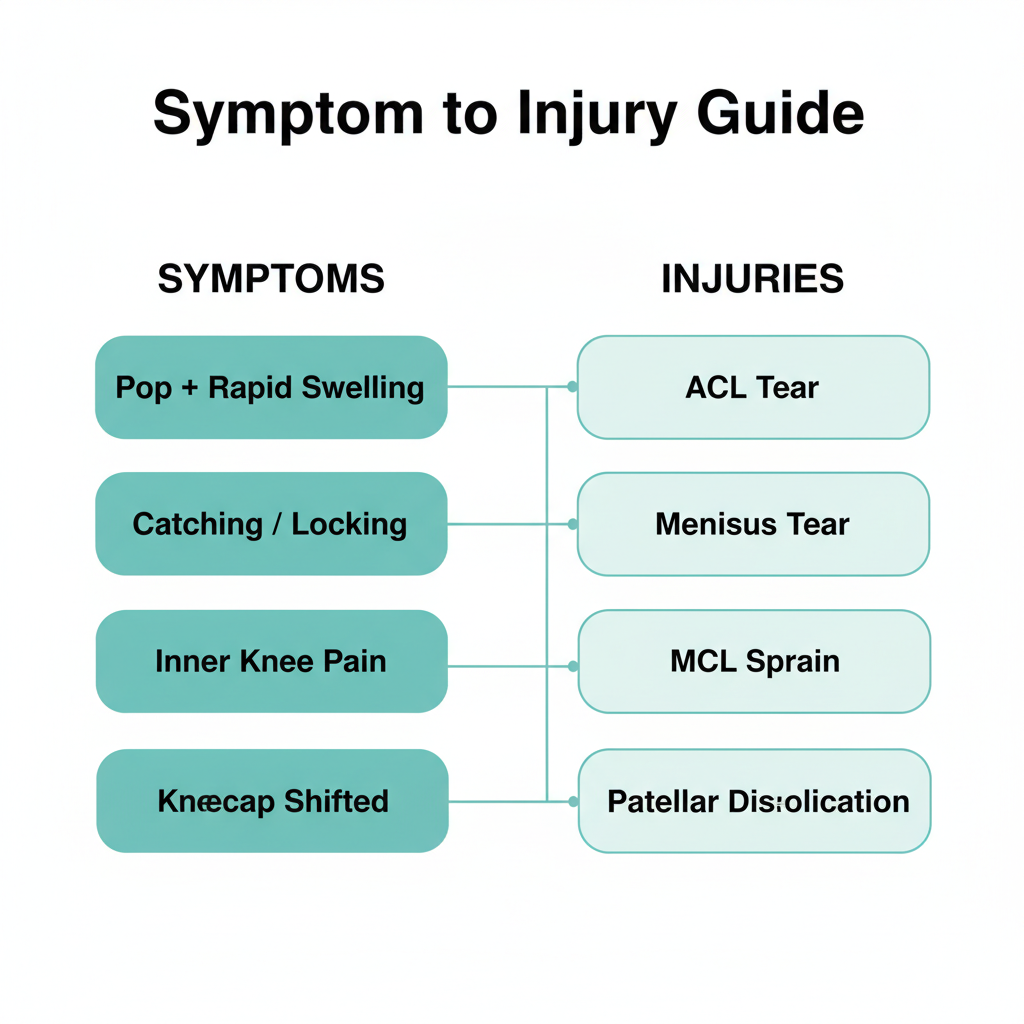
Different types of tears produce different symptom patterns. Use these as a guide, not a diagnosis — imaging and a physical exam are needed for confirmation.
ACL tear signs: Felt a pop during a pivot, jump landing, or sudden stop. Immediate swelling within 1 to 2 hours. Knee feels unstable when trying to change direction. Pain may actually decrease after the initial injury as adrenaline fades, which misleads patients into thinking the injury is minor.
Meniscus tear signs: Pain along the joint line (inner or outer edge of the knee). Clicking, catching, or locking during bending. Swelling that develops gradually over hours. Pain worsens with twisting, squatting, or pivoting. The knee may feel fine with straight-line walking but painful with any rotational movement. Learn more about this condition and related issues on our knee pain page.
MCL sprain or tear signs: Pain on the inner side of the knee. Injury usually involves a blow to the outside of the knee or a valgus stress (knee pushed inward). Swelling along the medial joint line. The knee feels unstable with side-to-side movement.
Patellar dislocation signs: The kneecap visibly shifted to the outside of the knee (may have relocated on its own). Significant swelling at the front of the knee. Pain with any bending attempt. Tenderness along the inner edge of the kneecap.
Not every knee injury requires the same level of urgency. Use this framework to decide your next step:
Go to the ER today if:
Schedule a specialist appointment this week if:
Monitor at home for 48 to 72 hours if:
If home monitoring does not result in clear improvement within 72 hours, transition to the specialist appointment category.
Delaying treatment for a significant knee injury does not just prolong pain. It can cause secondary damage that makes the eventual treatment more complex and the recovery longer.
Early diagnosis does not always mean aggressive treatment. Many injuries can be managed conservatively if caught early, but the same injuries may require surgery if left to worsen for months.

Understanding the evaluation process reduces anxiety and helps you prepare. At Sports Pain Management NYC, Dr. Melepura’s knee injury evaluation includes:
The goal is a clear diagnosis during the first visit whenever possible. Most patients leave with a specific answer and a treatment plan rather than a referral to another specialist weeks later.
The outdated framework of “rest it or get surgery” no longer applies. Modern knee injury treatment follows a spectrum, and most patients find their solution somewhere in the middle.
Grade 1 sprains, minor contusions, and mild overuse injuries respond to activity modification, bracing when indicated, and progressive rehabilitation. The key is structured physical therapy targeting strength and stability, not just passive rest.
When conservative care is not sufficient and surgery is not indicated, Dr. Melepura offers targeted, minimally invasive treatments:
These procedures take 15 to 30 minutes, require no downtime, and are performed in-office. Learn more on our knee injection treatments page.
Surgery is the right choice for complete ACL tears in active patients who need full stability, large or complex meniscus tears causing persistent locking, displaced fractures, and chronic instability that has not responded to rehabilitation and bracing. Dr. Melepura works closely with orthopedic surgeons and refers patients for surgical evaluation when the clinical picture clearly warrants it.
The advantage of seeing a pain management specialist first is that surgery is recommended only when truly necessary, not as a default. Many conditions that were historically treated surgically, including certain meniscus tears and partial ligament injuries, now respond well to non-surgical interventional approaches.
Recovering from a knee injury in New York City comes with unique challenges. You cannot simply stop walking. The average New Yorker takes 10,000 to 12,000 steps daily, navigates subway stairs multiple times a day, and has limited access to elevators in many pre-war buildings.
Practical recovery strategies for NYC patients:
Yes, and this is why many serious knee injuries go undiagnosed for weeks. A torn ACL allows walking because the other ligaments provide partial stability. A meniscus tear allows walking because the remaining cartilage still cushions the joint. The ability to walk does not mean the injury is minor. If you had a pop, swelling, instability, or locking, get evaluated regardless of whether you can walk.
A tear typically involves a felt or heard pop, rapid swelling, and mechanical symptoms like catching, locking, or instability. A sprain causes pain and swelling without the mechanical symptoms. Grade 1 and 2 sprains improve steadily over 1 to 3 weeks. If your symptoms are not clearly improving within that timeframe, imaging is needed to rule out a tear.
Go to the ER if you cannot bear any weight, the knee appears deformed, or you have numbness below the knee. For all other injuries, including those with swelling, instability, or a popping event, a specialist appointment within a few days provides more thorough evaluation and avoids the limitations of ER care, which typically includes only X-rays and a brace.
Not always. MRI is warranted when there is suspicion of a ligament tear, meniscus tear, cartilage damage, or when the clinical picture does not match the X-ray findings. A skilled specialist can often determine the likely diagnosis through physical examination alone and uses MRI to confirm the finding and plan treatment. MRI results are typically available within 48 to 72 hours of the order.
Mild sprains: 1 to 3 weeks. Moderate ligament sprains: 4 to 8 weeks. Meniscus tears treated conservatively: 6 to 12 weeks. ACL reconstruction recovery: 6 to 9 months. These are general ranges. Your specific timeline depends on the injury type, severity, treatment approach, and rehabilitation adherence. Dr. Melepura provides individualized recovery timelines based on your specific diagnosis.
If you are unsure whether your knee injury is serious, the safest decision is a professional evaluation. Dr. Melepura at Sports Pain Management NYC offers same-day appointments, in-office diagnostic imaging, and the full spectrum of non-surgical treatment options. Do not wait weeks wondering. Schedule your evaluation here.

Febin Melepura, MD is a top rated, best in class interventional pain management doctor. He is a nationally recognized pain relief specialist and is among the top pain care doctors in New York City and the country. He is an award winning expert and contributor to a prominent media outlets.
Dr. Febin Melepura has been recognized for his thoughtful, thorough, modern approach to treating chronic pain and, among other accolades, has been named a “top pain management doctor in New York”, and one of “America’s Top Doctors™” for an advanced sports injury treatments.

