

Upper Back Pain Treatment in New York City
Medically reviewed by Dr. Febin Melepura, MD · Last reviewed November 3, 2026
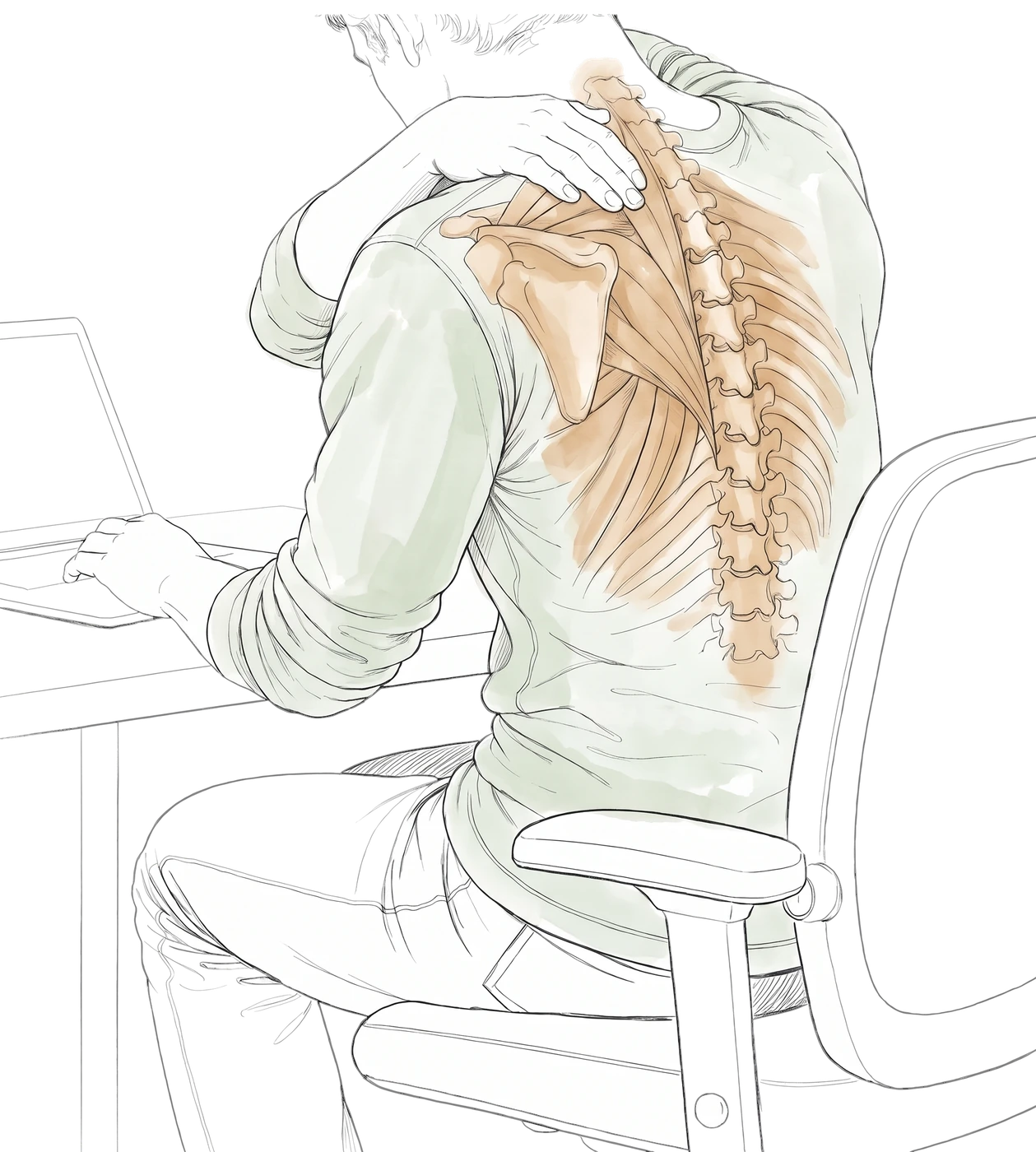
Sports Pain Institute of New York (SPIN) diagnoses and treats upper back pain at our Midtown Manhattan clinic. Upper back pain, also called thoracic spine pain, affects the area from the base of your neck down to the bottom of your rib cage. It can feel like a dull ache, sharp stabbing pain, burning, or muscle tightness, and may radiate into your shoulders, arms, or chest. If it persists beyond a couple of weeks, a back pain doctor in Midtown Manhattan can pinpoint the source before it becomes chronic.
Dr. Febin Melepura, a double board-certified pain specialist, uses precise diagnostics and minimally invasive procedures to find the root cause of your upper back pain and get you back to your normal life. Same-day appointments are available.
Upper Back Pain Treatment NYC · SPIN Sports Pain Specialists
Ready to find relief from upper back pain?
Same-day appointments available at our Midtown Manhattan clinic.
Symptoms of Upper Back Pain
You can feel upper left back pain or upper right back pain. The pain may also feel like it's coming directly from your spine, in the center of your back. Pain in the upper back can feel like a:
If any of these symptoms accompany your upper back pain, it is important to see a specialist promptly: nerve compression in the thoracic spine can cause symptoms far from the site of the injury.
Tingling, numbness or weakness in the arms and hands more often starts with a nerve in the neck than in the upper back. If that's your main symptom, read about a pinched nerve in the neck.
Nerves in the Upper Back and Upper Back Nerve Pain
Your upper back holds the thoracic spine: 12 vertebrae, T1 to T12, with the spinal cord running through the middle. At each level, a pair of thoracic spinal nerves leaves the spine. Most of them then run along the underside of a rib, where they're called intercostal nerves. That path is why nerve pain in the upper back so often wraps around the side of the chest in a band.
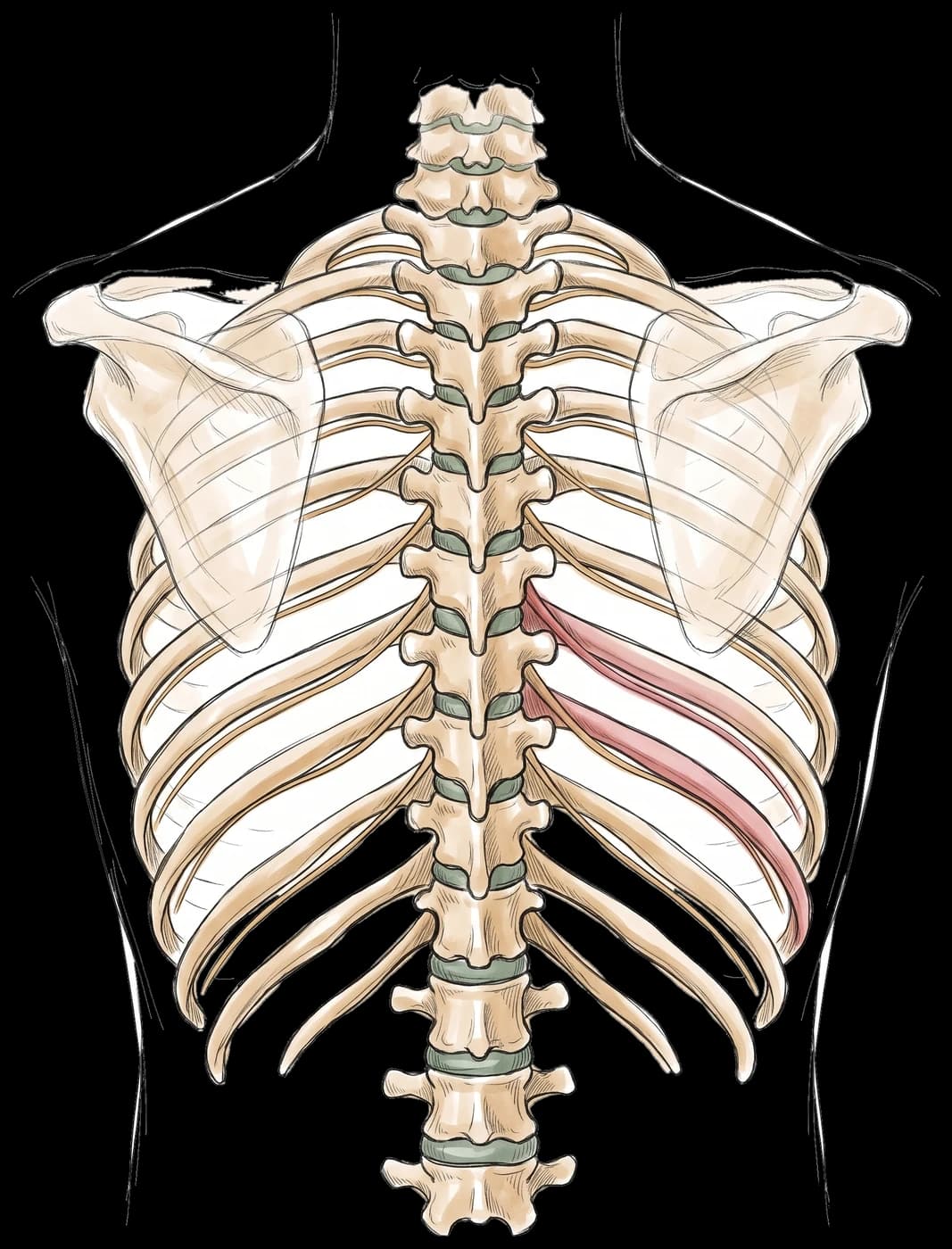
Some of the muscles across the top of your shoulders and between your shoulder blades are supplied by nerves that start in your neck. That's why a pinched nerve in the neck can show up as pain beside the shoulder blade.
What upper back nerve pain feels like
- Burning, sharp or electric pain, rather than a dull muscle ache
- Pain that wraps from your back around your ribs or chest, usually on one side
- Tingling, numbness or extra sensitivity of the skin on your back or chest
- Pain that gets worse when you twist, take a deep breath, cough or sneeze
Common causes
- A herniated disc or narrowing of the spinal canal pressing on a thoracic nerve root (thoracic radiculopathy)
- Arthritis of the facet joints narrowing the openings the nerves pass through
- Shingles, and the nerve pain that can linger after the rash heals (post-herpetic neuralgia)
- An irritated intercostal nerve after a rib injury or chest surgery (intercostal neuralgia)
- A compression fracture of a vertebra
How we treat it: once the source is confirmed, treatment can include physical therapy, medication for nerve pain, a thoracic epidural steroid injection to calm an inflamed nerve root, or an intercostal nerve block for a nerve along a rib.
Upper Right, Upper Left or Central Upper Back Pain
Where the pain sits gives your doctor a first clue:
- One side, upper right or upper left: most often a strained muscle, an irritated rib joint or facet joint on that side, or a nerve running along a rib.
- The center, over the spine: more often a disc, a facet joint, posture or, in older adults, a compression fracture.
- Between the shoulder blades: often posture and tight muscles, and sometimes a pinched nerve in the neck.
Upper back pain doesn't always come from the spine. The heart, lungs, esophagus and kidneys can all cause pain that is felt in the back.
Call 911 if upper back pain comes with chest pain or pressure, shortness of breath, sweating, nausea, or pain spreading to your arm, neck or jaw. These can be signs of a heart attack.
What Causes Upper Back Pain?
Your spine is composed of vertebral bones that are somewhat shaped like a ring. In the center, your spinal cord runs from the base of your spine up to your brain stem. Between each vertebral bone are discs, which act as shock absorbers. Each disc has a thick outer shell and a soft inner core that can bounce, stretch and move as you move. The discs keep your vertebrae from rubbing against each other.
The discs also keep your vertebrae spaced correctly, because nerves run out from the spinal cord between each pair of bones. If those spaces narrow, the nerves can get pinched. Common causes of upper back pain include:
- An accident or sports injury causing a vertebral fracture
- A pulled muscle, sprain, or muscle spasm
- Poor posture: slouching pulls the thoracic spine out of alignment over time
- Tech neck and forward head posture: pushing the upper spine out of its natural curve
- Herniated or bulging thoracic disc: uncommon but possible, pressing on nearby nerves
- Arthritis of the thoracic facet joints (facet joint syndrome)
- Myofascial pain syndrome: trigger points in the thoracic muscles causing referred pain
- Rib joint dysfunction: where the ribs connect to the thoracic vertebrae
- Scoliosis or kyphosis: abnormal curvature of the thoracic spine
- Osteoporosis: thinning bones that increase the risk of compression fractures
- Compressed or pinched thoracic nerve: causing pain that wraps around the chest wall
How We Treat Upper Back Pain at SPIN
Treatment for upper back pain always begins with the least invasive approach and steps up only if needed. At SPIN, Dr. Melepura designs a personalized plan based on the specific cause identified during your evaluation.
For most patients, upper back pain responds well to:
If your upper back pain has not improved after two to four weeks of conservative care, worsens over time, disrupts sleep, or is accompanied by arm tingling, numbness, or weakness, it is time to see a specialist. At SPIN, same-day appointments are available.
Minimally Invasive Treatments for Upper Back Pain at Our NYC Clinic
In severe cases (confirmed with X-rays, CT scans, or magnetic resonance imaging (MRI)), Dr. Melepura offers a range of minimally invasive procedures performed in-office at our Midtown Manhattan clinic:
Thoracic epidural steroid injection
delivers anti-inflammatory corticosteroid medication into the epidural space of the thoracic spine. Most effective for disc-related nerve compression causing radiating chest wall or rib pain. Relief often lasts from a few weeks to several months.
Thoracic facet joint injection
targets the small joints connecting the thoracic vertebrae. Used when arthritis or facet joint syndrome is the confirmed pain source. Also serves as a diagnostic tool.
Medial branch nerve block
a diagnostic injection that confirms whether the thoracic facet joints are the pain source. If successful, radiofrequency ablation may be the next step.
Radiofrequency ablation (RFA)
uses heat energy to interrupt pain signals from the thoracic facet joint nerves. Relief often lasts 6 to 12 months, sometimes longer, and the treatment can be repeated if the nerve grows back.
Trigger point injections
delivers medication directly into tight, knotted muscle bands (trigger points) in the thoracic muscles and upper back. Effective for myofascial pain syndrome.
Sympathetic nerve block
used for thoracic pain with a neuropathic or complex regional component. Delivered near the thoracic sympathetic nerve chain.
Spinal cord stimulation
considered for chronic, treatment-resistant upper back pain. A small implanted device delivers mild electrical impulses that interrupt pain signals before they reach the brain.
Ready to find relief from upper back pain?
Dr. Melepura's Midtown Manhattan clinic offers same-day appointments for evaluation and treatment.
Diagnosing Upper Back Pain in NYC
Accurate diagnosis is the foundation of effective treatment. Dr. Melepura uses a combination of clinical examination and advanced imaging to pinpoint the exact source of your upper back pain before recommending any procedure.
Diagnostic tools we use or coordinate:
Physical examination
evaluating posture, range of motion, and areas of tenderness to identify the pain pattern
X-ray
identifies vertebral fractures, bone spurs, and structural alignment issues
MRI (Magnetic Resonance Imaging)
the gold standard for visualizing soft tissue, discs, and nerve compression in the thoracic spine. We coordinate MRI referrals for NYC patients, including same-week appointments
CT scan
provides detailed cross-sectional imaging of the thoracic spine structure
Nerve conduction study / EMG
tests nerve and muscle function when arm or hand symptoms suggest nerve involvement
Diagnostic injections
medial branch blocks and facet injections that confirm whether a specific joint or nerve is the pain source
If you have existing imaging from another provider, bring it to your first appointment. Dr. Melepura will review it and advise whether additional studies are needed.
Why Choose SPIN for Upper Back Pain Treatment in NYC?
At SPIN, upper back pain is evaluated and treated by Dr. Febin Melepura: a double board-certified interventional pain management specialist, named one of America's Top Doctors by Castle Connolly. Unlike a general practitioner or urgent care clinic, SPIN focuses exclusively on diagnosing and treating pain with precision, using advanced procedures that most primary care offices do not offer.
Why patients from across NYC choose SPIN:

Board-certified interventional pain specialist: Dr. Melepura is fellowship-trained, nationally recognized, and listed as one of America's Top Doctors

Same-day appointments: no weeks-long wait to be seen

Full diagnostic capability: on-site evaluation and imaging coordination, including MRI referrals

Non-surgical first approach: we try conservative and minimally invasive options before surgery is discussed

Midtown Manhattan location: easily accessible from all five boroughs at 36 W 44th St, steps from Grand Central Terminal

Most major insurance accepted
100+ Real Stories from Our Patients



















Dr. Febin Melepura, MD
Double Board-Certified Pain Specialist
Meet Dr. Febin Melepura: Your Upper Back Pain Specialist in NYC
Dr. Febin Melepura, MD is a double board-certified interventional pain management specialist and the founder of the Sports Pain Institute of New York. He completed his residency and fellowship training at New York Presbyterian Hospital / Columbia University Medical Center, one of the nation's leading academic medical centers.
He holds dual board certifications from the American Board of Anesthesiology and the American Board of Pain Medicine, and has treated more than 7,500 patients and performed over 5,250 procedures throughout his career. He has been named a Top Pain Management Doctor in New York and one of America's Top Doctors™ by Castle Connolly.
Dr. Melepura's approach to upper back pain is rooted in precision: identify the exact source, treat it with a targeted injection, and get you back to your daily life as quickly as possible.
1,700+ Patient Reviews

"Able to make an appointment to see Dr. Melepura on short notice… attentive to my concerns… Jazmin was also very kind and helpful."

"Excellent hospitality, listener and explainer… highly recommend the doctor and the place."
"Dr. Melepura is the best! He worked with me to find the optimal solution to my shoulder pain while I was preparing for a fight!"
"Lovely, bright and modern… doctor and staff were kind… felt my concerns were heard."
"Helpful and friendly staff who gladly follows up with you if and when needed. Dr Melepura was very helpful and professional as well as provided me with excellent information and feedback."
"Dr Febin is fantastic! Highly recommend him and his practice the Spin clinic. The doctor is a good listener, kind, attentive and gave me great advice. "
"Dr.Melepura was very efficient and interpersonal, felt like he was understanding the problems I was having and explained the processes to take to rehabilitate. I would recommend."
"I felt listened to and truly understood by Dr. Melepura. Started PT the very next day. They were very friendly and I didn't feel rushed at all. Already recommended them to my friends who have or continue to play through pain."
Frequently Asked Questions About Upper Back Pain Treatment in NYC
A pain management specialist or orthopedic specialist is the right choice for persistent or severe upper back pain. At SPIN, Dr. Melepura is a board-certified interventional pain doctor who specializes in diagnosing and treating thoracic and upper back pain with minimally invasive procedures.
It depends on the cause. Muscle strain usually responds to rest, ice, and physical therapy. Facet joint pain responds well to thoracic facet injections or radiofrequency ablation. Disc-related nerve compression is treated with thoracic epidural steroid injections. Dr. Melepura diagnoses the specific cause before recommending any treatment.
Persistent upper back pain that does not respond to rest and over-the-counter medication usually has an underlying structural cause (such as a herniated disc, facet joint arthritis, or myofascial trigger points) that requires targeted treatment. If your pain has lasted more than two to four weeks, see a specialist.
Burning upper back pain is often caused by nerve irritation or myofascial trigger points. Ice or heat, anti-inflammatory medication, and gentle stretching can help temporarily. If the burning is persistent, radiates into your chest or arm, or is accompanied by numbness or weakness, see a pain specialist promptly: these can be signs of thoracic nerve compression.
Yes, the vast majority of upper back pain is treated without surgery. When it doesn't settle with physical therapy and medication, options such as thoracic epidural injections, facet injections, radiofrequency ablation and trigger point injections can help. At SPIN, surgery is considered only after conservative and minimally invasive options have been tried.
SPIN coordinates MRI referrals for patients who need imaging to diagnose thoracic spine conditions. We work with NYC imaging centers to arrange prompt appointments, often within the same week. If you already have MRI images, bring them to your first visit and Dr. Melepura will review them.
The upper back has 12 pairs of thoracic spinal nerves, one pair leaving the spine at each vertebra from T1 to T12. Most continue along the ribs as intercostal nerves, which is why upper back nerve pain often wraps around the chest. Some muscles between the shoulder blades are supplied by nerves from the neck instead.
Usually burning, sharp or electric rather than a dull ache. It often follows a band from the spine around the ribs on one side, and can come with tingling or numbness of the skin. Twisting, deep breaths, coughing or sneezing can make it worse.
Most often a strained muscle, an irritated rib joint or facet joint, or a nerve along a rib on that side. Less often, the pain comes from an organ such as the heart, lungs or kidneys. See a doctor if it hasn't improved within a couple of weeks, and call 911 if it comes with chest pain, shortness of breath, sweating or nausea.
Call 911 if upper back pain comes with chest pain or pressure, shortness of breath, sweating, nausea, or pain spreading to your arm, neck or jaw, as these can be signs of a heart attack. Go to the emergency room for upper back pain after a fall or accident, with a high fever, or with new weakness, numbness, or loss of bladder or bowel control.
Muscle pain is usually a dull ache or tightness that gets worse with certain movements or after long hours at a desk, often with tender spots you can press on. It tends to ease with heat, rest and gentle stretching. Pain that is burning, sharp or electric, wraps around your ribs, or comes with numbness, tingling or weakness points more to a nerve. Pain that doesn't change when you move, or that comes with chest pain, shortness of breath or fever, needs a doctor.
Not every cause can be prevented, but a few habits lower the risk. Take regular breaks from your desk or phone, keep your screen at eye level, and keep your shoulders back rather than rounded. Stay active and strengthen the muscles between your shoulder blades. Lift with your legs, carry heavy bags on both shoulders, and sleep with a pillow that keeps your neck level.
Rarely. Most upper back pain comes from muscles, joints or nerves. See a doctor promptly if the pain comes with unexplained weight loss, fever, night pain that doesn't ease when you change position, a history of cancer, or pain that keeps getting worse despite rest and treatment.
Book an Upper Back Pain Appointment in Midtown Manhattan
If upper back pain is affecting your work, sleep, or daily activities, do not wait for it to resolve on its own. Dr. Melepura sees patients from across New York City, including Midtown Manhattan, the Upper East Side, the Upper West Side and all five boroughs.
Same-day appointments are available. Call (212) 621-7746 or book online. Our clinic is located at 36 W 44th St, Suite 1416, steps from Grand Central Terminal.