Every time you look down at your phone, your neck absorbs more load than it was built to handle. For most people in New York City, that happens dozens of times a day - on the subway, at a desk, and in the hours before bed. The clinical result is tech neck: a pattern of cervical spine overload that is now one of the most common presentations at sports pain clinics across the city.
This article explains what tech neck is, how it damages the structures of the cervical spine, which symptoms signal a serious problem, and when self-care is no longer sufficient.
What Is Tech Neck?
Tech neck - also called text neck or forward head posture - is a repetitive strain injury of the cervical spine caused by holding the head in a downward, forward position during prolonged use of smartphones, tablets, laptops, or monitors positioned too low. It is not a single diagnosis but a clinical pattern: cervical disc overload, posterior muscle strain, and progressive flattening of the natural lordotic curve of the neck.
The average adult spends over 7 hours per day on screens. NYC office workers often exceed 10 hours when subway commutes and evening scrolling are included. The cervical spine was not engineered for this sustained forward load profile - and the damage accumulates silently over months before pain appears.
The Biomechanics: Why Your Neck Pays the Price
To understand why screen time damages the cervical spine, start with one number: the head weighs approximately 10-12 lbs in a neutral, upright position. For every degree it tilts forward, the effective compressive load on the cervical vertebrae increases sharply. At the angle most people hold their phones, this translates to five times the normal cervical load - sustained for hours at a time.
1. Forward Head Position - The Load Multiplier
At 0° (neutral), the cervical spine carries approximately 12 lbs. At 15° of forward tilt - the angle of looking at a phone held at chest level - this rises to 27 lbs. At 30°: 40 lbs. At 45°: 49 lbs. At 60° - the typical angle when reading a phone in the lap - the load reaches approximately 60 lbs. This is not a momentary spike; it is a sustained compressive force acting on the discs and vertebral endplates continuously throughout every screen session.
2. Disc Compression and Posterior Muscle Overload
Sustained forward head posture compresses the anterior cervical discs and places the posterior annular fibres under chronic tensile stress. The upper trapezius, levator scapulae, and suboccipital muscle groups work continuously to resist the forward head, accumulating fatigue and developing trigger points that generate referred pain into the head, shoulders, and upper arms.
3. Loss of Cervical Lordosis
The cervical spine has a natural inward curve (lordosis) that distributes mechanical load efficiently across the vertebral bodies. Chronic forward head posture flattens or reverses this curve over time - a finding visible on lateral cervical X-ray in long-standing cases. Loss of lordosis shifts load to the facet joints and discs in a mechanically unfavourable pattern, accelerating degenerative change well beyond what normal ageing would produce.
Tech Neck Symptoms: What Does It Feel Like?
Tech neck presents across a spectrum from mild to severe. Symptoms typically worsen as the day progresses and peak in the evening after extended screen use.
1. Neck Pain and Upper Back Stiffness
Dull, aching pain in the posterior neck and upper trapezius region that eases with movement in the morning and returns - progressively worse - with screen use. Bilateral tenderness at the levator scapulae insertion is a consistent finding on palpation. In moderate cases, stiffness extends into the upper back and limits rotation or lateral bending of the neck. Left unaddressed, this chronic muscle overload can develop into painful neck muscle spasms.
2. Cervicogenic Headaches
Headaches that originate in the upper cervical spine and radiate to the base of the skull, behind the eyes, or across the forehead. They are triggered by sustained neck postures and relieved - at least temporarily - by neck movement. Unlike migraine, they do not respond well to standard headache medication, but they do respond to neck treatment. When these headaches persist, an occipital nerve block can provide lasting relief.
3. Arm Tingling and Numbness
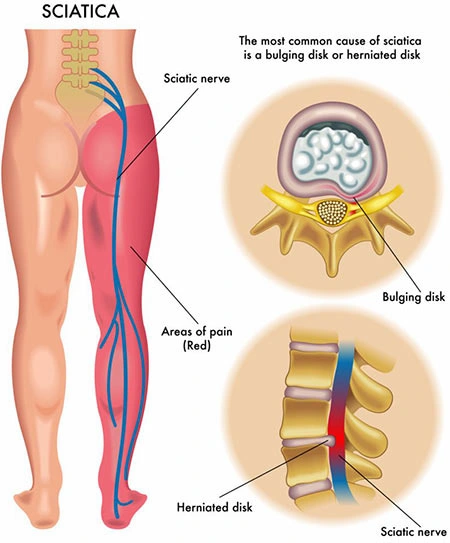
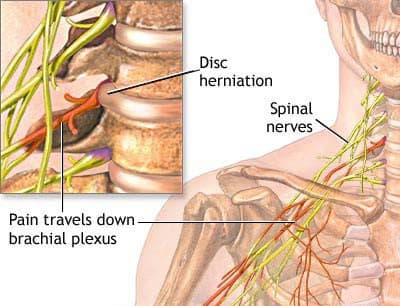
When forward head posture progresses to nerve root compression - from disc herniation or osteophyte formation at the cervical foramen - symptoms extend into the arm. Tingling, numbness, or weakness following a dermatomal distribution from the neck into the hand indicates cervical radiculopathy. This is a red flag finding that requires prompt clinical evaluation rather than continued self-management.
Is Tech Neck Pain Normal? How to Tell
Some neck discomfort after an unusually long day at a screen is normal - it eases overnight and resolves with movement. What is not normal is pain that returns every day, builds progressively over weeks, or extends beyond the neck into the arm or hand.
Use this three-point guide to assess where you stand:
Monitor and adjust — Mild neck fatigue that resolves with standing and movement, and does not return the next morning. Reduce screen time, correct your posture, and start the chin tuck exercise daily. If symptoms clear within a week, no further action is needed.
Seek early assessment — Stiffness or pain that returns on every screen day despite corrected posture, or headaches that occur consistently on high-screen days. Book a sports medicine appointment within two weeks rather than waiting for it to worsen.
Seek prompt assessment — Arm pain, tingling, or numbness into the hand; headaches with visual changes or nausea; progressive weakness in grip. These are nerve root signs - see a specialist the same week.
Who Is Most at Risk?
Tech neck affects all age groups, but certain populations in New York City carry disproportionately high risk. Office workers spend 8+ hours at a desk, commute 45-90 minutes on phones, and continue screen use in the evening - exposing the cervical spine to 11 or more hours of forward load daily. Students, remote workers without ergonomic setups, gamers, and healthcare workers charting on mobile workstations are similarly high-risk.
The consistent pattern: the more screen time and the worse the posture, the faster structural changes accumulate. A 45-year-old with poor screen habits develops cervical disc changes more rapidly than a 25-year-old with the same habits. Starting corrective action early reduces long-term structural damage significantly.
How to Fix Tech Neck (What You Can Try First)
If symptoms are mild and recent, these steps are worth attempting before scheduling a clinic visit.
1. Correct your screen position.
Raise your phone to eye level rather than bending your neck to meet it. Set your monitor so the top of the screen is at or slightly below eye level at arm's length. These two changes reduce the average forward head angle from 45-60° to near 0° and cut cervical load by more than half - without any exercises at all.
2. Perform the chin tuck daily.
The chin tuck (cervical retraction) is the single most effective exercise for tech neck. Pull the chin straight back to create a "double chin" - hold 5 seconds, 10 reps, three times per day. This reactivates the deep neck flexors (the muscles most inhibited by forward head posture) and gradually restores neutral head-on-neck alignment. It is more effective than neck stretches, which address the symptom rather than the cause.
3. Address the shoulders and thoracic spine.
Rounded shoulders accompany virtually every case of tech neck and must be addressed alongside the neck. Shoulder blade squeezes (retract and depress, 10 reps), doorway chest stretches (hold 30 seconds), and thoracic extension over a foam roller correct the thoracic kyphosis that drives the cervical forward head position. The levator scapulae stretch - tilt head to one side, rotate 45° toward that shoulder, flex the chin - targets the most consistently overloaded muscle in tech neck.
4. Take movement breaks every 30 minutes.
A 2-minute movement break every 30 minutes of screen time prevents the progressive fatiguing of posterior neck muscles that generates end-of-day pain. Set a repeating timer. Standing, walking, and performing two or three chin tucks during each break resets cervical load and significantly reduces cumulative tissue stress across the working day.
When to See a Sports Pain Specialist in NYC
Self-management has a clear limit. Book an appointment with a neck pain specialist in NYC when any of the following apply:
- Neck pain or stiffness has persisted for more than two weeks despite corrected posture and regular exercise.
- You have arm pain, tingling, or numbness - particularly if it follows a path from the neck down into a specific finger or hand region.
- You have new or progressive weakness in the hand or grip.
- Headaches are daily, severe, or accompanied by visual changes or nausea.
- Symptoms are worsening rather than improving despite self-care.
NYC office workers and athletes tend to manage neck pain with ibuprofen and posture reminders far longer than is clinically appropriate. When nerve root signs appear - arm tingling, progressive weakness - prompt evaluation prevents the kind of established cervical radiculopathy that requires injections or surgical referral.
How Sports Pain Management NYC Treats Tech Neck
- Evaluation begins with a postural assessment, cervical range of motion testing, and a neurological screen for radiculopathy. If nerve root involvement is suspected, cervical MRI is ordered. Treatment is staged to severity.
- Physical therapy is the foundation of tech neck treatment. A structured programme targets the deep neck flexors, rhomboids, and mid-trapezius with progressive strengthening; adds manual therapy - joint mobilisation and soft tissue work - for pain control and mobility; and systematically addresses the ergonomic habits that are maintaining the problem. Most mild-to-moderate cases respond within 6 to 12 weeks with consistent treatment.
- Trigger point injections are used when upper trapezius or levator scapulae trigger points are maintaining pain and limiting rehabilitation progress. They break the pain-spasm cycle and allow physiotherapy to advance more effectively than stretching alone can achieve.
- Cervical epidural steroid injections are reserved for confirmed nerve root compression causing radicular arm symptoms that have not responded to conservative management. They reduce perineural inflammation, relieve radicular pain, and allow the neural tissue to recover function so that active rehabilitation can proceed.
Conclusion
Tech neck is a structural problem with a structural solution. Correcting screen position and strengthening the right muscles resolves most cases - but the correction needs to be consistent and the exercises need to target the right structures. For most NYC office workers, this means a few weeks of the right programme under professional guidance, not months of self-managed stretching that addresses the symptom rather than the cause.
If your neck has been stiff, painful, or generating headaches for more than two weeks, stop managing it solo and get a proper assessment. Tech neck caught early is straightforward to treat. Tech neck with established disc changes takes longer - and the window to avoid that outcome closes faster than most people realise.
Frequently Asked Questions
Tech neck is reversible in most cases with physiotherapy and postural correction. Structural disc changes from long-standing cases may persist on imaging, but pain and function improve significantly with treatment.
Yes. 2. Cervicogenic Headaches are one of the most common tech neck symptoms. They arise from referred pain in the upper cervical joints and suboccipital muscles, and they resolve with neck treatment rather than headache medication.
Mild cases respond in 4 to 6 weeks with consistent exercise and ergonomic correction. Moderate cases with disc involvement typically require 8 to 12 weeks of structured physiotherapy.
No. Braces weaken the neck muscles and delay recovery. Strengthening and postural correction are the treatment - not immobilisation.
Yes, when forward head posture has progressed to cervical nerve root compression. Arm or hand numbness requires clinical evaluation and will not resolve with stretching alone.