Key Takeaways
- Real sciatica hurts more in the leg than in the back, usually on one side and often down to the foot. Back pain on its own probably isn't sciatica.
- Pelvic girdle pain affects up to 1 in 5 pregnant women and can feel a lot like sciatica, so get it looked at before you pick exercises.
- Staying active, water exercise, careful use of heat and sleeping on your side with a pillow between your knees are safe places to start. Check new exercises with your ob-gyn.
- Ask your ob-gyn before taking any painkiller. The FDA says to avoid NSAIDs like ibuprofen from 20 weeks unless your clinician tells you otherwise.
- Numbness around the genitals or anus, new bladder or bowel trouble, or weakness in both legs means going to the ER.
- If sciatica is still around after your baby is born, injections and physical therapy can help, and breastfeeding doesn't automatically rule out an injection.
What Sciatica Feels Like During Pregnancy
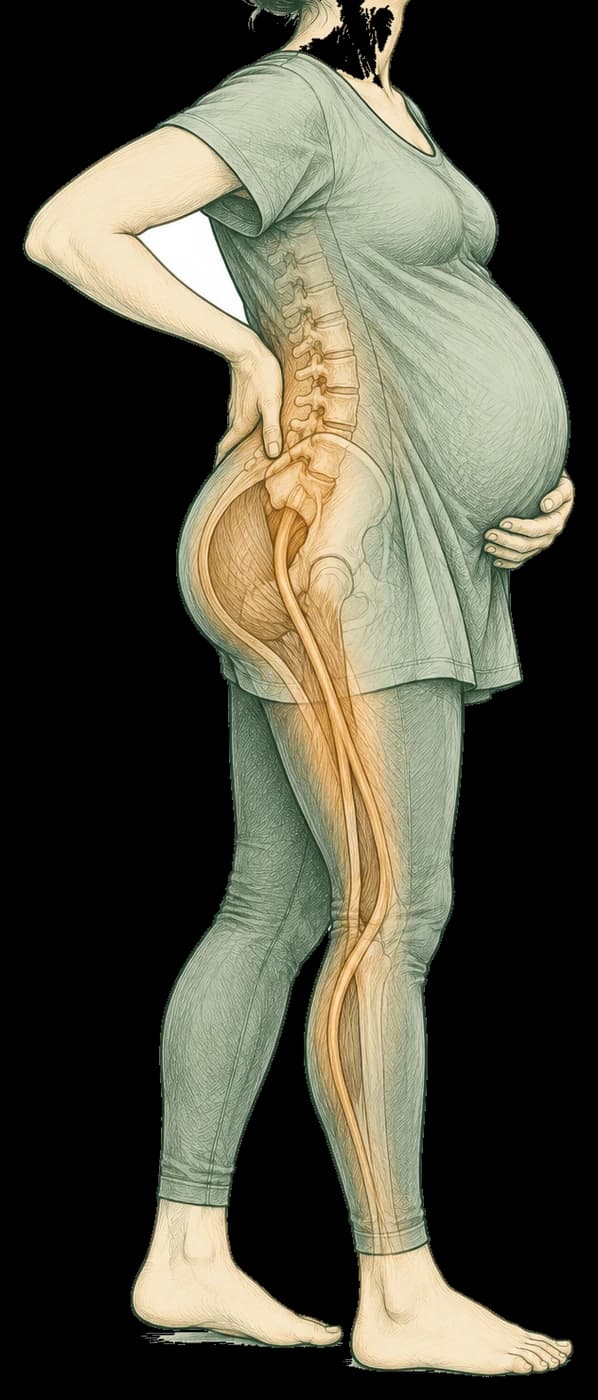
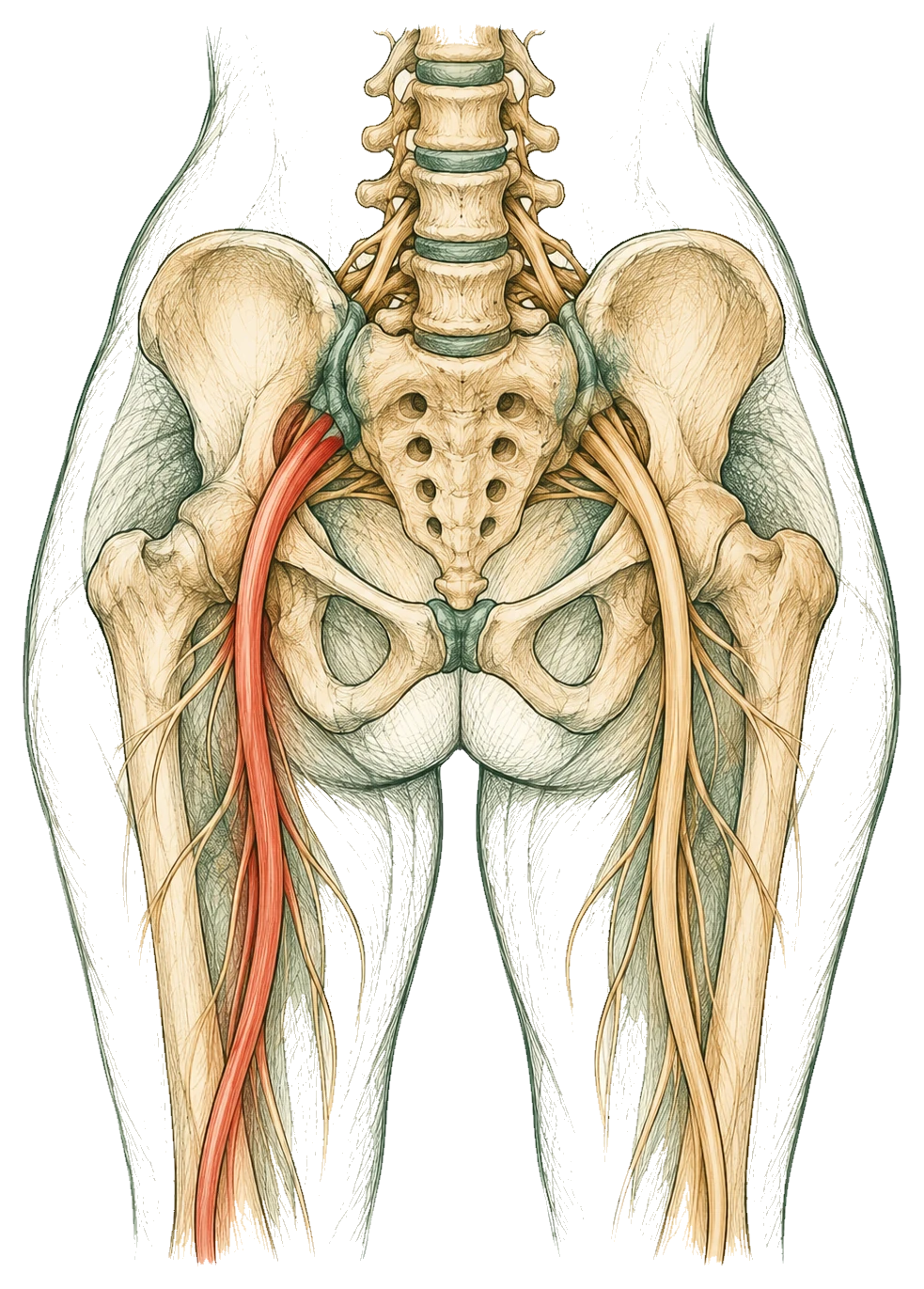
Sciatica is nerve pain. It usually starts in the buttock and runs down the back of one leg, often into the foot and toes, and the leg tends to hurt more than the back does. If all you have is back pain, it's probably not sciatica.
People describe it as burning, or like an electric shock running down the leg. Coughing, sneezing or bending forward can set it off, and you might notice numbness, tingling or a weak feeling in part of the leg or foot.
Pregnancy can confuse things a little. A growing uterus can press on nerves in the legs and cause numbness and tingling in the legs and toes on its own, even when the sciatic nerve isn't the problem.
Is It Sciatica, Pelvic Girdle Pain or Round Ligament Pain?
A lot of pain in pregnancy gets called sciatica when it's actually coming from the pelvis. Pelvic girdle pain (PGP) affects up to 1 in 5 pregnant women, and because it can shoot or burn down into the thigh, the two are easy to mix up. Use this table as a rough guide, not a diagnosis.
| Sciatica | Pelvic girdle pain (including SI joint pain) | Round ligament pain | |
|---|---|---|---|
| Where it hurts | Buttock and the back of one leg, often down to the foot | Over the pubic bone, across one or both sides of the lower back, in the perineum, sometimes into the thighs | Lower belly or groin |
| What it feels like | Burning or electric-shock pain, sometimes with numbness, tingling or weakness | Shooting, burning, stabbing or throbbing pain; some women feel or hear clicking or grinding in the pelvis | A stretching feeling or pain |
| What sets it off or eases it | Coughing, sneezing or bending | Stairs, standing on one leg, rolling over in bed, moving your legs apart | Eases when you move slowly or change position |
| When it happens | Any time; often better after birth | Any time; usually better after birth | Most often between 18 and 24 weeks |
Sources: NHS sciatica, NHS pelvic pain in pregnancy, Cleveland Clinic, MedlinePlus, RCOG.
It helps to notice what sets the pain off. Pelvic girdle pain tends to flare on the subway stairs, when you roll over in bed, or when you swing your legs out of a car or cab. Sciatica is more likely to flare when you cough, sneeze or bend forward.
The SI joints, where your spine meets your pelvis, are a common source of trouble in pregnancy, and SI joint dysfunction can send pain into the buttock and leg in a way that looks a lot like true sciatica. Piriformis syndrome is another one: a muscle deep in the buttock irritates the sciatic nerve, the pain sits deep in the buttock, it gets worse after long sits or drives, and it usually stops above the knee. Sorting these out takes a hands-on exam, and after delivery it can also include a diagnostic injection.
If one leg is painful and swollen and the other isn't, call your provider right away. That can be a sign of a blood clot, not sciatica.
What Causes Sciatica During Pregnancy?
Your body is loosening up for birth, and that changes how your spine and pelvis handle weight. Pregnancy hormones loosen the ligaments in your spine, which can put more pressure on your nerves, and the baby itself can press on the sciatic nerve. Weight gain on its own usually isn't the reason.
Much of this comes down to relaxin, a hormone your body may start making as early as 10 weeks. It relaxes the ligaments in your pelvis so the baby can get through the birth canal, and if those joints get too loose, back pain can follow. At the same time, your growing belly pulls your center of gravity forward and stretches your stomach muscles, so your back ends up doing more of the work. Even the baby's position plays a part: a head resting against your tailbone or lower back can add to the pain.
All of this is why back pain is so common in pregnancy, affecting about 40% of pregnant women at some point. If you had back pain before this pregnancy, or in a previous one, you're more likely to get it again.
Outside pregnancy, the most common cause of sciatica is a slipped disc, and being pregnant doesn't rule that out. If the leg pain is severe, keeps getting worse, or comes with numbness or weakness that won't go away, get it examined rather than putting it down to the pregnancy.
Safe Ways to Ease Sciatica While You Are Pregnant
The things that help most aren't complicated. Keep moving, pay attention to how you sit and stand, and bring in a physical therapist if the pain isn't settling. Check any new exercise with your ob-gyn first, and stop anything that hurts.
- Keep moving. If you don't have complications that rule it out, staying active actually reduces back pain in pregnancy. Water exercise is especially good because the water takes your weight. For a healthy pregnancy, ACOG's target is at least 150 minutes of moderate activity a week, which works out to about 30 minutes on five days.
- Heat or cold, used carefully. A heating pad on its lowest setting, wrapped in a towel, for about 15 minutes is fine, as long as it doesn't warm you up overall. A cold compress works too.
- Don't stay put for too long. Try not to sit or lie down for long periods. On desk days, the RCOG suggests getting up at least every 30 minutes; if you're on your feet all day, rest one foot on a low stool or box to take the strain off your back.
- Support your back and your bump. A chair with good back support, or a small pillow tucked behind your lower back, helps over a long commute or workday. So can a maternity support garment, which takes the weight of your belly off your back muscles.
- Shoes. Go for low-heeled (not completely flat) shoes with good arch support, like walking shoes or sneakers, and skip high heels.
- Lift with your knees. If you have to pick something up, squat down, bend your knees and keep your back straight rather than bending at the waist.
- Physical therapy. If the pain isn't settling, ask your ob-gyn about seeing a physical therapist. For pelvic girdle pain, treatment is safe at any stage of pregnancy.
- Massage or a warm shower. Both can ease things. If you book a massage, tell the therapist you're pregnant.
Be choosy about stretches. A lot of sciatica routines, including our own
,
weren't written for pregnancy and include moves done lying on your back or face down. ACOG recommends
avoiding lying flat on your back
as much as possible while pregnant and skipping jerky, bouncy or high-impact moves, so ask your ob-gyn or a physical therapist who treats pregnant patients which stretches suit you.
How to Sleep With Sciatica When You Are Pregnant
Lie on your side with your knees bent, one pillow between your knees and another under your belly. A full-length body pillow does both jobs at once, and side sleeping is the best position later in pregnancy anyway.
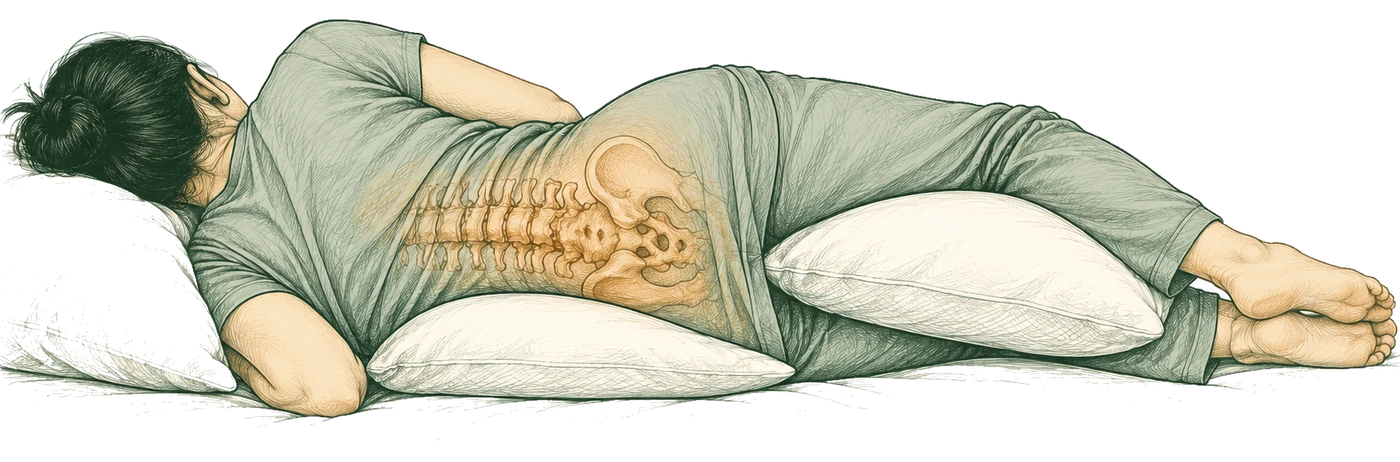
If your pelvis hurts too, lie on the less painful side and keep your knees together when you roll over. The same trick helps when you get in and out of a car. Your mattress should support you properly; if it's soft, the NHS suggests a piece of hardboard underneath to firm it up.
Plenty of women find their back hurts more at night, after a long day of carrying the extra weight. If the pain is waking you most nights or getting worse, tell your ob-gyn rather than putting up with it.
What Pain Medicine Is Safe for Sciatica in Pregnancy?
Check with your ob-gyn before you take anything, including over-the-counter pills. Acetaminophen (Tylenol) is the usual choice: ACOG supports using it as needed, in moderation, after talking with your ob-gyn.
Ibuprofen and other NSAIDs need more caution. The FDA says pregnant women shouldn't take them from 20 weeks on unless a doctor specifically says to, because they can cause rare but serious kidney problems in the baby and low amniotic fluid. Around 30 weeks they can also affect the baby's heart. They show up in a lot of cold and pain products, so check the Drug Facts label.
You may have seen the headlines about Tylenol. In September 2025, the FDA started the process of updating acetaminophen's label because some studies suggest a possible link with autism and ADHD. The FDA itself says a causal link hasn't been established and that using it is still reasonable in some situations, and ACOG points out that untreated pain carries its own risks in pregnancy. That's a conversation to have with your ob-gyn.
Acetaminophen also doesn't do much for sciatica itself, which is another reason to lean on movement, positioning and physical therapy.
Warning Signs: When to Call Your Doctor or Go to the ER
Some symptoms can't wait. They can mean pressure on the nerves at the base of the spine (cauda equina syndrome) or a problem with the pregnancy.
Call 911 or go to the ER if you have:
- sciatica in both legs
- weakness or numbness in both legs that's severe or getting worse
- numbness around or under your genitals, or around your anus
- trouble starting to pee, being unable to pee, or losing control of your bladder or bowels, when that isn't normal for you
- lost feeling in one or both legs, your bottom or your genitals
Don't drive yourself. Have someone take you, or call 911. Speed matters. Treating cauda equina syndrome within 48 hours makes a real difference to recovering nerve, bladder and bowel function, and left untreated it can cause permanent paralysis and incontinence.
Call your ob-gyn right away if you have:
- back pain with a fever, burning when you pee, or vaginal bleeding, which can mean a urinary tract infection or preterm labor
- pain that comes on suddenly and sharply, or cramping in your hips or belly; in the second or third trimester, back pain can be a sign of early labor
- pain and swelling in one leg but not the other
- numbness, tingling or weakness in a leg that doesn't go away
- back pain that's severe or lasts more than two weeks
Does Sciatica Go Away After Pregnancy?
Usually, yes. It often gets better after the baby arrives, although numbness and tingling from pregnancy can take a few weeks to a few months to clear completely.
It doesn't always go quickly, though. For many women, back pain hangs on for months after birth, and around 1 in 10 women with pelvic girdle pain still have pain afterwards. Part of the reason is that your core and pelvic floor are often weak after delivery, so your lower back is doing work it isn't built for, as we explain in our guide to lower back pain in women.
Then there's all the lifting. A newborn gets picked up, rocked and carried all day, and the RCOG suggests avoiding stooping, bending or twisting to lift a baby, and not carrying one on your hip.
Most mild sciatica settles within 4 to 6 weeks, as our sciatica treatment page explains. If yours hasn't, or it's severe, or it comes with numbness or weakness, it's time to get it checked.
Sciatica Treatment After Giving Birth
Once your baby is here, there's more we can do. At SPIN, Dr. Melepura treats sciatica after delivery with image-guided injections and physical therapy, on top of the everyday steps that helped during pregnancy.
It starts with finding the cause. That means a proper exam: a straight leg raise test, reflexes, a check of sensation and strength, and questions about where the pain travels and what makes it better or worse. You don't usually need a scan straight away unless symptoms are severe or getting worse. If you do, an MRI shows whether a disc is pressing on a nerve root.
Then rebuilding strength. After an uncomplicated vaginal birth, it's usually fine to start exercising within a few days, or whenever you feel ready; after a C-section or complications, check with your ob-gyn first. Simple core and back exercises plus Kegels for the pelvic floor are the place to start, and physical therapy builds on that with core strength, hip mobility and posture work.
If the pain hangs on, an injection. When pain is severe and hasn't settled with other treatment, an injection can calm the irritated nerve. Every injection at SPIN is guided by X-ray or ultrasound, and depending on the cause it could be:
- a lumbar epidural steroid injection, which puts anti-inflammatory medicine around the compressed nerve root. Most patients feel a real improvement within 3 to 7 days, and relief usually lasts between 3 weeks and 6 months.
- a selective nerve root block, when one specific nerve root is the problem
- a sacroiliac joint injection, when the SI joint is the source
- a piriformis injection, when that muscle is irritating the nerve
An injection isn't a cure on its own. Cleveland Clinic describes spinal injections as short-term relief in some cases, which is why we use the pain-free window they give you for physical therapy, to make it less likely the sciatica comes back.
After an epidural steroid injection, don't drive that day, and avoid heavy lifting and strenuous activity for 2 to 3 days. With a newborn at home, line up some help for those days.
Surgery is rarely needed. It's kept for things like worsening leg weakness or bladder and bowel problems, and if you need it, Dr. Melepura will refer you to a spine surgeon.
Breastfeeding and Sciatica Treatment
Breastfeeding doesn't automatically rule out a steroid injection. NHS pharmacy guidance says steroids can be used while breastfeeding at the lowest dose and for the shortest time possible, and it names methylprednisolone as a preferred choice because only negligible to very small amounts reach breast milk.
There have been a few reports of injected steroids temporarily lowering milk supply, so if your supply dips, keep an eye on your baby's weight gain. Let Dr. Melepura know you're breastfeeding so the medicine and the timing can be chosen with that in mind.
For everyday pain while breastfeeding, acetaminophen is usually the best choice, and ibuprofen is often fine if you need it.
Frequently Asked Questions
It can start at any point. Back pain is more common in the second and third trimesters, and the hormone that loosens your pelvic ligaments may be made from as early as 10 weeks.
Usually a burning or electric-shock pain in the buttock and the back of one leg, often down to the foot, with the leg hurting more than the back. Pain mostly over the pubic bone or the back of the pelvis that flares on stairs or when you roll over in bed is more likely pelvic girdle pain.
Get emergency care for numbness around the genitals or anus, new bladder or bowel problems, sciatica in both legs, or weakness in both legs. Back pain with a fever, burning when you pee or vaginal bleeding also needs a call to your ob-gyn, because it can mean an infection or preterm labor.
On your side with your knees bent, a pillow between your knees and another under your belly, or with a full-length body pillow. If your pelvis hurts too, keep your knees together when you roll over.
Not unless your clinician says so. The FDA advises avoiding NSAIDs such as ibuprofen from 20 weeks of pregnancy, and ACOG supports acetaminophen taken as needed after talking with your ob-gyn.
It often gets better after birth, though numbness and tingling can take a few weeks to months to clear. If leg pain is still there 4 to 6 weeks after delivery, is severe, or comes with numbness or weakness, have it checked.
Often, yes. NHS pharmacy guidance says steroids can be used while breastfeeding at the lowest dose possible, with methylprednisolone a preferred choice, although there are a few reports of a temporary dip in milk supply.
Yes. At SPIN in Midtown Manhattan, Dr. Febin Melepura treats sciatica after delivery, with options that include image-guided injections and physical therapy. During pregnancy, start with your ob-gyn.
Get Help With Sciatica After Your Baby Is Born
If sciatica is still making the newborn weeks harder than they should be, you don't have to just live with it. Dr. Febin Melepura is a double board-certified pain medicine physician in Midtown Manhattan who treats sciatica after delivery with image-guided injections and physical therapy. Book an appointment and we'll work out what's causing it and what your options are.